Has your pool pump started screeching, grinding or rattling? Or does it hum without starting properly?
A change in sound can point to worn bearings, debris inside the pump or a starting fault. The sound helps narrow the investigation, but it cannot confirm the cause on its own. Some noisy pumps can be repaired; the decision depends on the fault and the condition of the equipment.
If the pump has developed a harsh, unfamiliar noise, switch it off and arrange an assessment. Also stop it if it is not priming or there is no water flow.
Screeching or a high-pitched noise
A high-pitched screech can indicate worn motor bearings. These support the rotating motor shaft, and wear can make the pump much louder than its usual operating sound.
A bearing problem does not automatically mean the whole pump needs replacing. On a repairable pump, an overhaul may involve replacing bearings and seals, with the capacitor checked and replaced where needed.
The pump needs inspecting before deciding what work is worthwhile. Its age, general condition and how long the problem has continued all matter.
Grinding or a raspy sound
Grinding can also be associated with worn bearings, but debris around the impeller is another possible cause.
The impeller is the rotating part inside the pump that moves water. If something has lodged around it, the pump can develop a grinding or raspy sound.
Distinguishing a bearing fault from trapped debris requires inspection. Leave opening the pump housing and checking its internal components to a technician.
Humming or buzzing without starting
A pump that hums or buzzes but does not start turning has a different problem from one that runs noisily.
On a conventional single-speed pump, a failed capacitor is one possible cause. The capacitor is an electrical component involved in motor starting or operation. It needs testing rather than replacement based on the sound alone.
Switch the pump off rather than repeatedly trying to start it. Leave electrical diagnosis and capacitor work to a suitably qualified technician.
Rattling, vibration or a sound like gravel
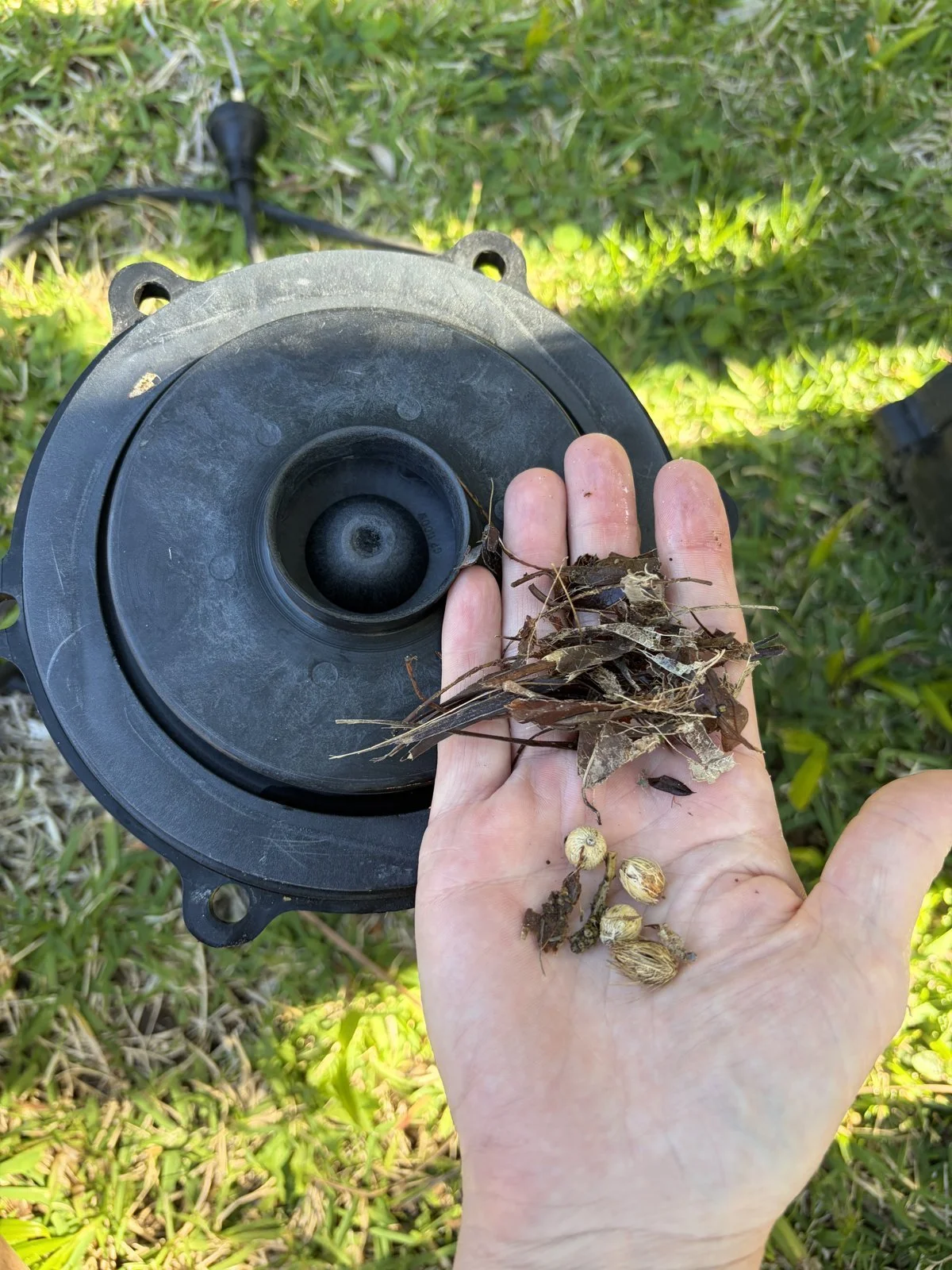
Leaves, twigs and seed pods removed from a pool pump impeller during a service.
Debris that has passed the pump basket can sometimes collect around the impeller and produce a rattling or gravelly sound. Seeds or small pieces of grit are examples of material that may be found during inspection. Debris can also come from a damaged impeller, so the inspection needs to check the component’s condition as well as remove any loose material.
This can be repairable if the obstruction is removed and the affected components remain in serviceable condition. However, the sound alone does not establish that debris is the cause. A technician needs to check the pump and its operation before recommending a repair.
How do you know whether the noise is abnormal?
Every pump sounds slightly different. Compare it with its own usual sound rather than another pool’s equipment.
The useful clue is a change: a new screech, a harsher grinding sound, persistent rattling or a hum without the motor starting. Describe what has changed and whether water is still circulating when arranging an assessment.
You do not need to identify the failed part yourself. A clear description of the symptom helps guide the investigation.
Can a noisy pool pump be repaired?
Many noise-related faults are repairable, particularly on conventional pumps with replaceable bearings, seals and other components. Removing debris may resolve a noise where no lasting damage has occurred.
We assess the fault alongside the pump’s age, quality and overall condition. A good-quality pump in otherwise sound condition may be worth repairing. Heavy corrosion or deterioration can make replacement a more sensible use of the money.
The design matters too. Repair options vary between models, particularly variable-speed pumps, so an overhaul that is practical for one pump may not be available or economical for another.
When should you turn it off and get help?
Switch the pump off if:
- It develops a new, harsh screeching, grinding or rattling noise.
- It hums or buzzes without starting properly.
- It fails to prime or has no water flow.
- It appears to be overheating.
Continuing to run a pump without water can damage it. Do not open the housing or electrical covers to investigate the noise yourself.
Clarity Pool Services can assess noisy pool pumps on the Sunshine Coast and advise whether repair or replacement makes sense. Tell us the pump’s brand and model, what the noise sounds like, and whether it starts and moves water normally.
Or call 0400 976 004.