Your pool pump is making its usual running sound, but there is little or no water returning to the pool. Before assuming the pump needs replacing, check the water level, baskets, cleaner connections, pump lid and filter valve.
These checks can help you identify a simple problem or give a technician useful information about what is happening.
If the pump is running without water, switch it off. Do not leave it running while you investigate.
1. Check the pool water level
Start at the skimmer—the opening in the pool wall where surface water enters the filtration system.
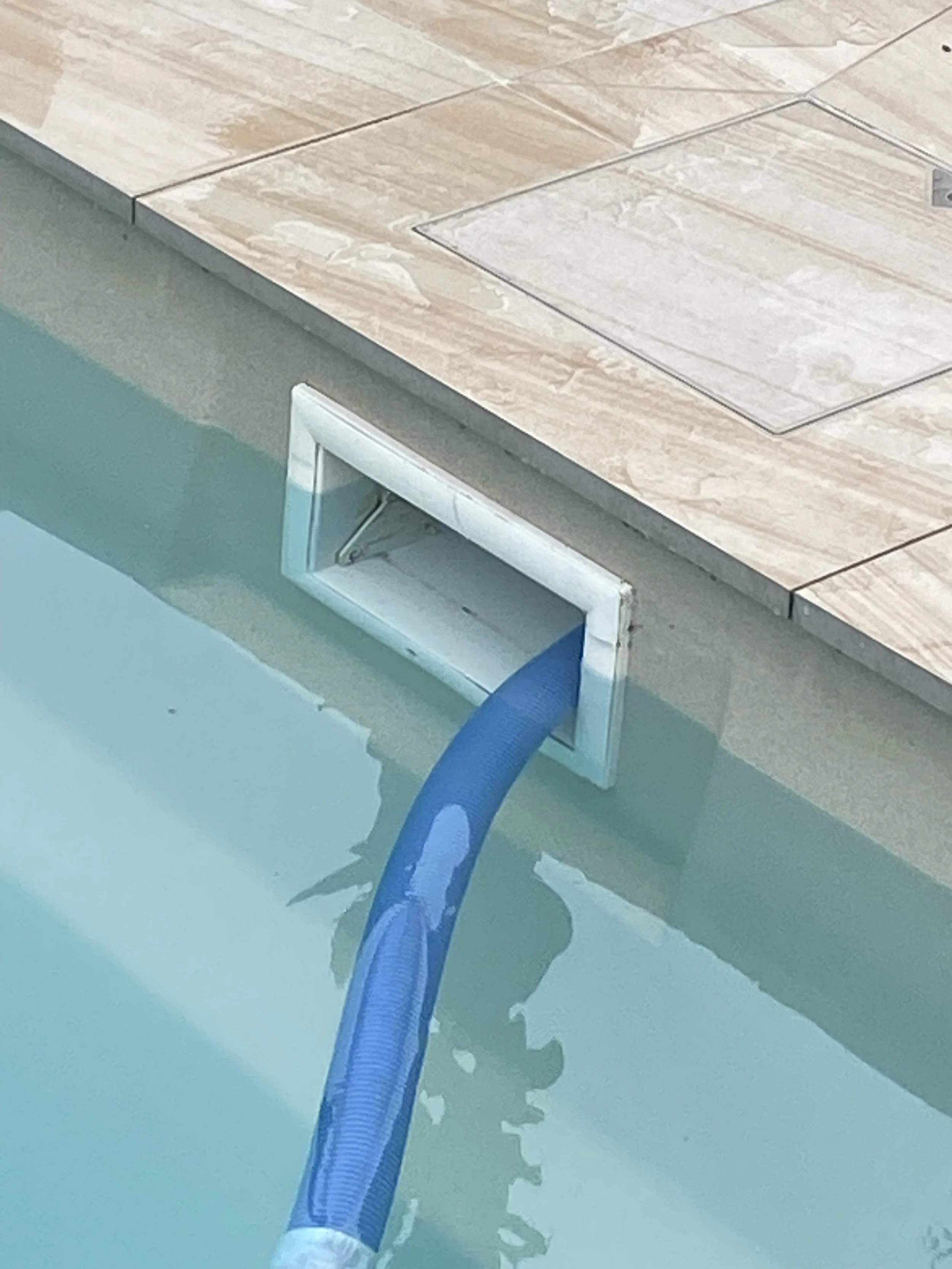
Pool water correctly filled to three quarters of the way up the skimmer opening, allowing a steady supply of water to the pump.
If the water level is too low, the skimmer cannot supply enough water to the pump. The pump may draw in air and lose prime, meaning it loses the water it needs to pump effectively.
Check that the water reaches the operating level recommended for your skimmer. If it is too low, restore the level before attempting to restart the system.
2. Check for blocked baskets
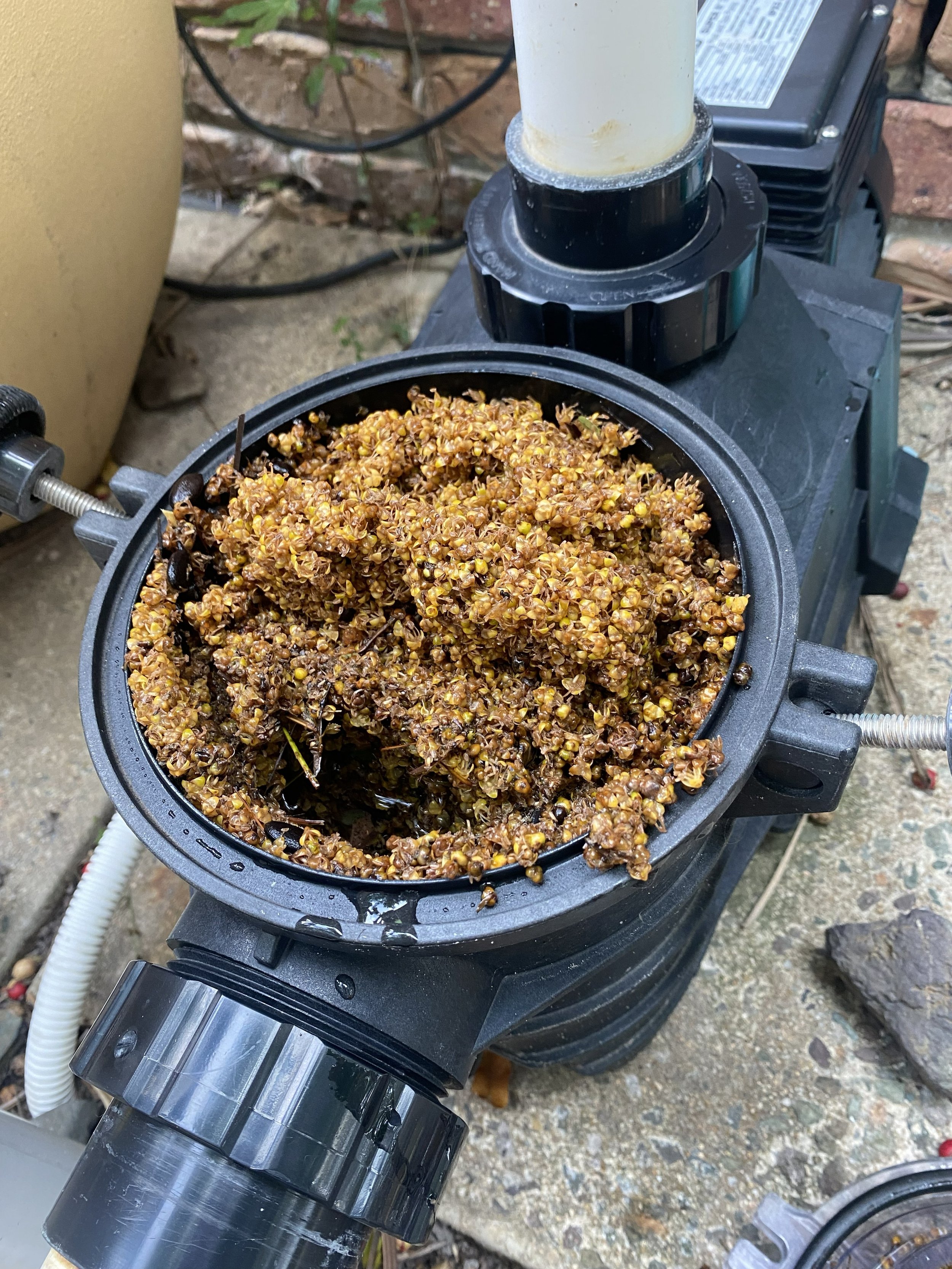
A pump basket packed with leaves and plant debris, which can restrict water flow. Switch off and safely isolate the pump before opening the lid.
With the pump switched off, check the skimmer basket. Leaves, debris and even pool toys can restrict water entering the system. Empty the basket and remove any obvious obstruction.
The pump has a separate basket, usually beneath a clear lid. This can also collect debris and restrict flow.
Before opening the pump lid, isolate its power so a timer cannot restart it, and release system pressure according to your equipment’s instructions. If you are unsure how to do this, leave the pump basket check to a professional.
3. Check whether the suction cleaner is involved
If your pool has a suction cleaner connected through the skimmer, its hose and connections are part of the water supply to the pump.
With the pump off, disconnect the cleaner and remove its vacuum plate—the attachment inside the skimmer that connects the cleaner hose. Follow your system’s instructions for returning it to normal filtration.
If circulation returns after the pump is correctly primed and restarted without the cleaner, the cleaner hose or its connections deserve closer investigation.
On one job, the pump repeatedly lost prime whenever the suction cleaner was connected. We traced the problem to a small crack in the cleaner hose that was drawing in air. The symptoms appeared at the pump, but the hose was causing the problem.
4. Check the pump lid seal
If the problem started after you emptied the pump basket, check the lid’s rubber O ring. It can fall out when the lid is removed. Without it, air can enter and prevent the pump from priming.
During a safely isolated, pressure-free basket check, make sure the O ring is present and seated correctly. If the seal is damaged or the lid will not fit properly, get help rather than forcing it closed.
If the pump needs priming, follow the procedure for your model. Priming usually involves restoring water to the pump before starting it, but the exact steps depend on the equipment.
5. Check the filter valve position
If your filter has a multiport valve—the handle with settings such as Filter, Backwash and Rinse—check that it is in the normal Filter position.
A valve left on Closed can prevent circulation. This is worth checking if the problem started after filter maintenance.
Switch the pump off before moving the multiport handle. Follow the valve’s instructions and avoid changing unfamiliar valves at random.
What if there is still little or no flow?
Look through the pump’s clear lid, if it has one, without opening it while running.
A pump that repeatedly fills with air or cannot stay primed needs its water supply and possible air leaks investigated. A pump that remains full of water but produces weak return flow may need the filter, valves, pipework or internal pump components checked.
These observations help narrow the investigation; they do not confirm a particular fault. If the pump repeatedly loses prime, our article Pool Pump Losing Prime — Why It Happens and What to Check explains the different patterns to watch for.
When should you stop the pump?
Switch the pump off if it cannot establish water flow, becomes much noisier than usual or appears to be overheating. Do not touch hot equipment to test its temperature.
A chlorinator’s no-flow warning can also alert you to a circulation problem. Check what the message means for your model and do not bypass the warning.
If the basic checks do not restore reliable circulation, Clarity Pool Services can investigate the cause. Tell us whether the problem began after maintenance, happens only with the cleaner connected, or continues after priming. These details help us assess what needs attention.